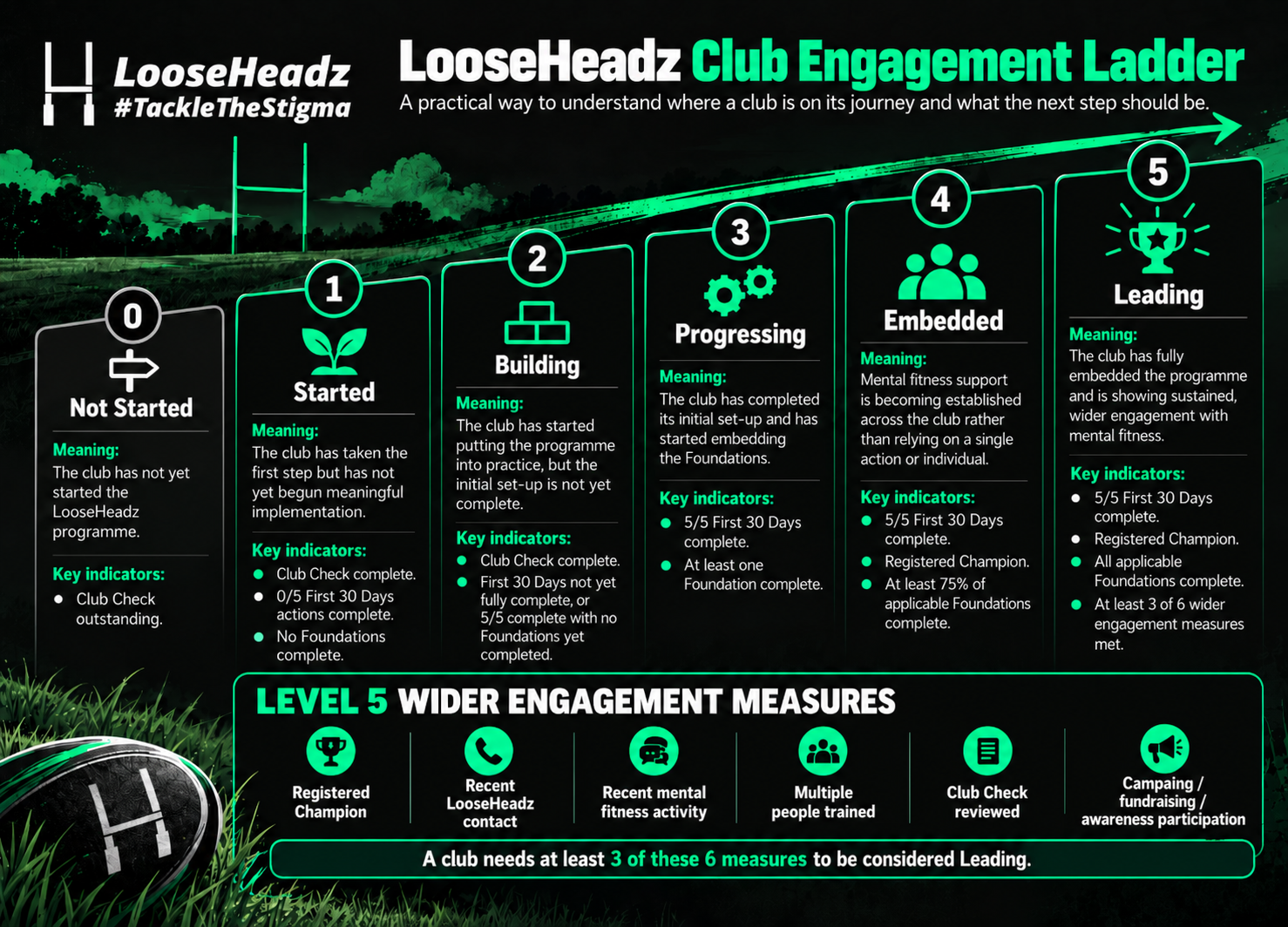
Everything you need to know about the Club Check, Club Hub, First 30 Days, Foundations and your club’s progress through the LooseHeadz programme.
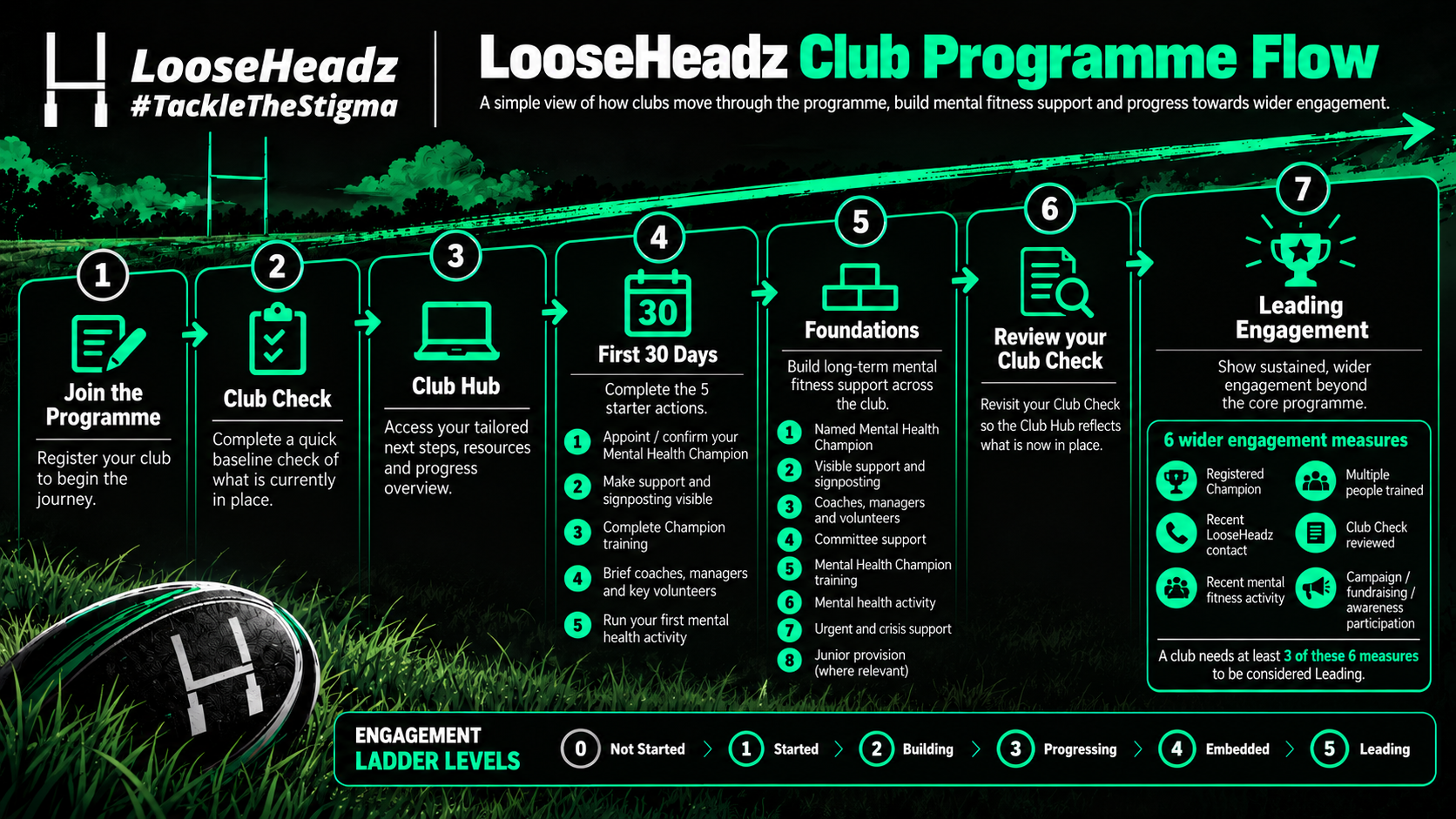
Start with the Club Check, work through your First 30 Days and Foundations, then keep your progress up to date through regular reviews and wider engagement.
The LooseHeadz Club Programme helps clubs build stronger, more consistent mental health support over time. It gives clubs a clear starting point, practical actions to complete, ongoing Foundations to work towards, and a Club Hub where progress can be tracked.
The programme follows a simple journey: Join the Programme, complete your Club Check, use your Club Hub, work through your First 30 Days and Foundations, review your Club Check, and continue building wider engagement. Your Club Hub brings everything together and shows what your club has completed, what to focus on next and the resources available to help.
The Club Check is a short baseline assessment of what your club currently has in place to support mental fitness. It is not a pass or fail assessment. Its purpose is to understand your starting point and help identify the most useful next steps for your club.
The Club Check should only take a few minutes to complete.
The Club Check should be completed by someone who understands how mental health support currently works within the club, usually a Club Lead or Mental Health Champion.
Once the Club Check has been completed, your Club Hub becomes available. The Hub shows your First 30 Days progress, your Club Foundations, your current priorities, relevant resources and support, and areas that may need reviewing or updating.
The Club Hub is available to authorised club users linked to the club, such as Club Leads and Mental Health Champions, once the Club Check has been completed.
If your account is linked to more than one club, you can select which club you want to view and manage within the programme.
The First 30 Days are five practical starter actions designed to help your club put the core parts of the programme in place: appoint or confirm your Mental Health Champion, make support and signposting visible, complete Champion training, brief coaches, managers and key volunteers, and run your first mental health activity.
No. The First 30 Days are designed as an early-action framework rather than a strict deadline. The aim is to help clubs build momentum and put the most important initial steps in place as early as possible.
Yes. If a Mental Health Champion is currently registered against your club, the Club Hub will recognise this automatically. Pending Champion applications do not count until they have been approved and linked to the club.
Yes. If a registered Mental Health Champion has verified LooseHeadz training associated with their account, the Club Hub will recognise this automatically.
The Foundations represent the longer-term areas that help embed mental fitness support across the club. They include a named Mental Health Champion, visible support and signposting, coaches, managers and volunteers, committee support, Mental Health Champion training, mental health activity, urgent and crisis support, and junior provision where relevant.
The First 30 Days are your starter actions. The Foundations are about making those actions part of how the club operates over time. For example, running one mental health activity can complete a First 30 Days action, while the Mental Health Activity Foundation looks at whether the club has an ongoing plan for future activity.
Because the two stages measure different things. The First 30 Days checks whether an initial action has happened. A Foundation checks whether that area has become established and sustainable within the club.
Developing means the club has started work in that area, but the Foundation has not yet been fully confirmed as complete. For example, completing your first mental health activity is an important milestone, but the Mental Health Activity Foundation is only complete once an ongoing activity plan is in place.
This Foundation looks at whether the club has an ongoing plan to create opportunities for people to talk about mental fitness and look after each other. The club can record when the ongoing plan was agreed and how often activity is planned.
Yes. The Club Hub is designed to reflect the club’s current position rather than permanently locking progress. If something that was previously in place is no longer current, the club’s status can be reviewed and updated.
Most Foundations apply to all clubs, but some may not be relevant in every case. For example, Junior Provision may not apply to a club without a junior section. Only applicable Foundations are included when calculating progress.
Yes. Clubs should review the Club Check periodically so that the Club Hub continues to reflect what is currently in place. Reviewing the Club Check also helps you see how your club has progressed since the original assessment.
No. Your original Club Check completion remains on record. When you review the Club Check, your latest answers update the current Club Hub view while the original baseline is preserved.
Recent mental health activity is separate from completing the Mental Health Activity Foundation. It records the date of a recent mental fitness activity your club has run. If that activity took place within the last 12 months, it can contribute towards your club’s wider engagement score.
Your Mental Health Activity Foundation can remain complete if your ongoing plan is still in place. However, the Recent Mental Fitness Activity wider-engagement measure will stop counting until a newer activity is recorded.
Your Club Hub includes relevant resources alongside the areas you are working on. You may also see recommended resources, practical downloads, guidance and support information based on your club’s current progress.
Club Leads can update club roles through the club management area. Once the new Mental Health Champion is approved and linked to the club, the Club Hub will update to reflect the change.
First check that your club details, Mental Health Champion information and programme confirmations are up to date. If something still does not look right, contact LooseHeadz and we can review the club record with you.
The engagement ladder helps show where a club currently sits within the programme. Clubs can move from Not Started, to Started, Building, Progressing, Embedded and finally Leading as more of the programme becomes established.
Level 5 – Leading means the club has completed all five First 30 Days actions, has a registered Mental Health Champion, has completed all applicable Foundations, and meets at least three of the six wider engagement measures.
The six wider engagement measures are: a registered Mental Health Champion, recent LooseHeadz contact, recent mental fitness activity, multiple people trained, Club Check reviewed, and campaign, fundraising or awareness participation. A club needs to meet at least three of these six measures to be considered Leading.
This measure is met when at least two verified certificated learners are linked to the club.
A qualifying conversation or contact with LooseHeadz within the last six months can count towards this wider engagement measure.
Participation in a qualifying LooseHeadz campaign, fundraising activity or awareness initiative within the last 12 months can contribute towards wider engagement.
Yes. The engagement ladder is designed to show your club’s current position rather than award a permanent badge. Some wider engagement measures are time-based, so a club’s level may change if activity, contact or participation becomes out of date.
No. The programme is designed to help clubs understand where they are now, what they already have in place and what would be most useful to work on next.